top of page

Fundamental Geometric Figures

Points: Points have a location but no dimension.
Lines: Lines extend in opposite directions without end. Lines have one dimension, length. Through any two points, there is only one line that exists.
Planes: Planes extend in two dimensions endlessly. The two dimensions that planes occupy are length and width. Flat surfaces represent planes. Through any three noncollinear points, there is only one plane.
Segments: Segments are composed of two endpoints and all of the points between them.
Rays: Rays are composed of a single endpoint and all of the points on one side of that endpoint. Rays extend infinitely in a single direction.
Opposite Rays: Opposite rays are composed of two rays that share an endpoint. Opposite rays form a line.
Space: A region where geometric figures can exist.
Geometric Figures: Figures that occupy space. Points are the simplest geometric figures.
.png)
Collinear Points: Points that lie on the same line.
Coplanar Points: Points that lie on the same plane.

Intersection: The set of points that two or more geometric figures have in common. If two lines intersect, they intersect at exactly one point. If two planes intersect, they intersect in exactly one line.
Measuring Segments


Coordinate: A real number that corresponds to a point.
The absolute value of the difference of two coordinates is the distance between their two corresponding points.

Congruent Segments (≅): Segments that have equal lengths (=) are considered to be congruent (≅).
Tick Marks: Tick marks indicate that segments are congruent. Congruent segments contain the same number of tick marks, tick marks with the same length, or the same color tick marks.

Segment Addition: Smaller segments can be added together to determine the length of longer segments.


Midpoint: A point that divides a larger segment into two smaller congruent segments.
Bisector: A line, plane, or ray that intersects a segment at its midpoint.
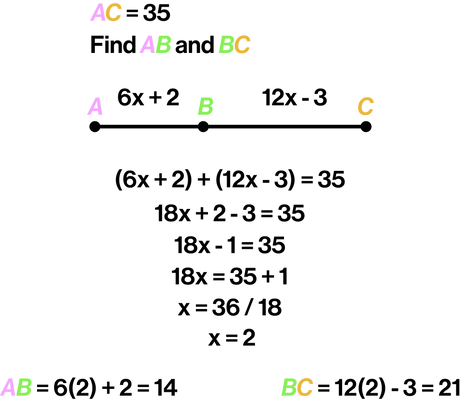
Segment calculations may involve algebra.
Geometric Figure Relationships

Perpendicular Lines (⊥): Lines that intersect to form right angles.

Parallel Lines (∥): Coplanar lines that do not intersect.
Parallel Arrows (▼): Indicate that lines are parallel.

Parallel Planes (∥): Planes that do not intersect.

Skew Lines: Lines that are noncoplanar, nonparallel, and do not intersect.

Transversal: A line that intersects two or more coplanar lines at different points.

If three or more parallel lines form congruent segments on one transversal, then they form congruent segments on every transversal.
Angles

Angles: An angle is composed of two rays that share a common endpoint. Angles are named using the angle symbol (∠) followed by the angle's corresponding vertex (∠ A) or a corresponding number (∠ 1). Angles may also be named starting with a point on one included ray, followed by the angle's vertex, and completed with a point on the other included ray
(∠ BAC) (∠ CAB).
Sides: An angle's rays.
Vertex: The common endpoint of the rays.
Interior: Points that are within the angle.
Exterior: Points that are not in the interior or on the angle itself.


Angles can be measured in degrees or radians.
Degrees (°): A unit of measurement for angles. 360° is a full rotation.
Radians (π): A unit of measurement for angles. 2π is a full rotation.
Unit Circle (Geometry): A tool that shows the degrees and radians of specific angles.

Measurement (m∠): Indicates the measurement of an angle in degrees or radians.

Angles are classified based on their magnitude.
Acute Angles: Angles that measure less than 90°.
Right Angles: Angles that measure 90° and are marked by a square.
Obtuse Angles: Angles that measure greater than 90°.
Straight Angles: Angles that measure 180° and are marked by a semicircle.

Congruent Angles (≅): Angles that have equal measurements (=) are considered to be congruent (≅).
Arcs: Arcs indicate that angles are congruent. Congruent angles contain the same number of arcs or arcs with the same color.

Angle Addition: The measurements of smaller angles can be added together to determine the measurement of a combined angle.

Angle calculations may involve algebra.
Angle Relationships

Adjacent Angles: Adjacent angles share a common side and a common vertex; however, they do not share any common interior points.
Vertical Angles: Angles whose sides form opposite rays. Vertical angles are congruent.
Linear Pair: Angles whose noncommon sides are opposite rays.
Complementary Angles: Angles that, when added, equal 90°.
Supplementary Angles: Angles that, when added, equal 180°.

Angle Bisector: A ray that divides an angle into two congruent adjacent angles.


Special names are given to angles formed by transversals.
Alternate Interior Angles: Nonadjacent interior angles that are on opposite sides of the transversal.
Alternate Exterior Angles: Nonadjacent exterior angles that are on opposite sides of the transversal.
Same-side Interior Angles: Interior angles that lie on the same side of the transversal.
Corresponding Angles: Angles that lie on the same side of the transversal in corresponding positions.

Theorems apply to transversals that pass through parallel lines.

If two lines are perpendicular, they form four right angles.
Polygons


Polygons: Shapes that are flat, closed, two-dimensional, and composed of straight sides. Polygons are named using their vertices.
Vertices: The endpoints of the sides of a polygon.
Sides: The straight line segments of a polygon.

Convex Polygons: Polygons that do not have a side that extends into their interior.
Concave Polygons: Polygons that have at least one side that extends into their interior.
.png)
Equilateral Polygons: Polygons with sides that are all congruent.
Equiangular Polygons: Polygons with angles that are all congruent.
Regular Polygons: Polygons with sides that are all congruent and angles that are all congruent.

Diagonals: Segments that join two nonconsecutive vertices of a convex polygon. Diagonals can be used to determine the number of triangles that make up a polygon and the sum of the polygon's interior angles.


The sum of the interior angles of a convex polygon can be determined by the number of sides it has. If the convex polygon is regular, each angle of the polygon can be determined based on the number of sides the figure has.


The sum of the exterior angles of every convex polygon is 360°. For a regular convex polygon, the measurements of its exterior angles can be calculated by dividing 360° by the number of exterior angles.

Tessellation: A repeating pattern of figures without any gaps or overlaps. To ensure there are no gaps between figures, the sum of the angles where the figures meet must equal 360°.

Congruent Figures: Figures that are the same size and shape. Applying a rigid transformation to congruent figures does not affect their congruence.
Triangles
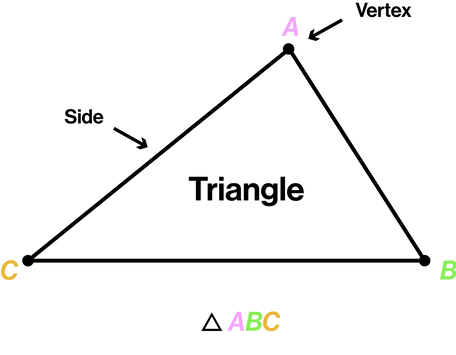

Triangle (△): A geometric figure formed by three noncollinear points connected by segments. Triangles are named using the triangle symbol (△) and the letters associated with each of the triangle's vertices.
Vertices: The noncollinear points of a triangle.
Sides: The segments that join the vertices of a triangle together.

Adjacent Sides: Two sides of a triangle that share a common vertex.
Opposite Side: The side not directly connected to the common vertex.

Triangles are classified by their angles or sides.

The sides of right triangles have special names. The longest side is called the hypotenuse, and the shorter sides are legs.
The sides of isosceles triangles have special names. The sides of equal length are the legs, and the side to which the legs connect is the base.

The interior angles of a triangle always add to a sum of 180°.

The measurement of an exterior angle of a triangle equals the sum of the measures of its two nonadjacent interior angles.

The acute angles of a right triangle are complementary.


Two theorems apply specifically to isosceles triangles.

All equiangular triangles are also equilateral and vice versa.

There are five ways to determine if a set of triangles are congruent.
Included Side: A side shared by two angles.
Included Angle: An angle shared by two sides.
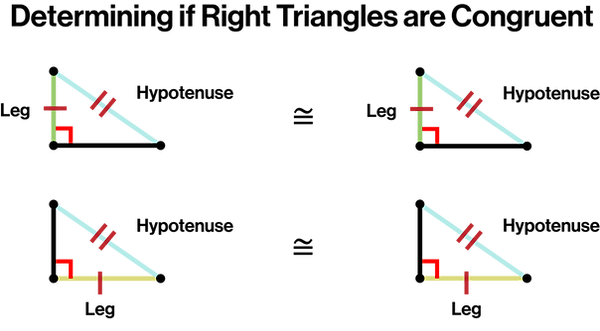
If the hypotenuse and at least one leg of a right triangle are congruent to the hypotenuse and leg of another right triangle, then the triangles are congruent.

Perpendicular Bisector (Triangle): A line that is perpendicular to a side of a triangle at the side's midpoint. Triangles have three perpendicular bisectors.
Concurrent: When three or more lines meet at a single point, the point is called the point of concurrency.
Circumscribe: A figure drawn about another figure.
Circumcenter: The point of concurrency of the perpendicular bisectors. The circumcenter is also the center of a circle circumscribed about the triangle.
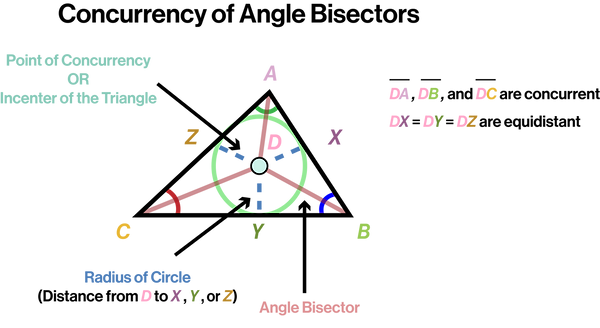
Angle Bisector (Triangle): A line that bisects an angle of a triangle. There are three angle bisectors for each triangle.
Inscribe: A figure drawn within another figure.
Incenter: The point of concurrency of the angle bisectors. The incenter of a triangle is always within the triangle. The incenter is also the center of an inscribed circle that touches each side once.

Median (Triangle): A segment composed of an endpoint that is a vertex and an endpoint that is a midpoint on the side opposite the vertex.
Centroid: The point of concurrency of the medians. Also, the point where a triangle of uniform thickness will balance. The centroid is always inside the triangle.

Altitude (Triangle): A perpendicular segment that is composed of an endpoint that is a vertex and an endpoint that is on the line containing the opposite side. An altitude can exist inside, outside, or on the side of a triangle.
Orthocenter: The point of concurrency of the altitudes. The orthocenter can be inside, outside, or on the triangle.

Midsegment (Triangle): A segment that joins together two midpoints of a triangle. A midsegment is parallel to and half as long as the third side of the triangle that isn't joined. Each triangle has three midsegments.

Triangle Inequality: If two sides of a triangle are not congruent, then the angle opposite the longer side is larger than the angle opposite the shorter side.

Triangle Inequality (Sides): The sum of the lengths of any two sides of a triangle will always be greater than the length of the third side.

Hinge Theorem: If two sides of one triangle are congruent to another triangle, and the included angles are not congruent, the third side of the triangle is longer on the triangle with the larger included angle.
Right Triangles and Trigonometry


Pythagorean Theorem: An equation that solves for an unknown side length of a right triangle using the two known sides.


The 45°-45°-90° and the 30°-60°-90° right triangles have special properties. The Pythagorean theorem is not required when solving for the sides of these triangles.

Trigonometric Ratios: Trigonometric ratios are used to relate the side lengths of a right triangle to its interior angle measurements.

Vector (⇀): Any quantity with direction and magnitude. Vectors are named using the half arrow symbol (⇀) above either a single letter that represents the whole vector or two letters that correspond to the vector's initial and terminal points.
Initial Point: The location where a vector begins.
Terminal Point: The location where a vector ends.

Component Form 〈X,Y〉: A way to represent a vector in a coordinate plane.


Vector Addition: Combining two vectors via their component forms. A vector sum can show what happens when vectors occur in sequence or when vectors act at the same time.
Law of Sines, Law of Cosines, and Oblique Triangles

Oblique Triangles: Triangles that do not contain a right angle. An oblique triangle can either have three acute angles or two acute angles and one obtuse angle.


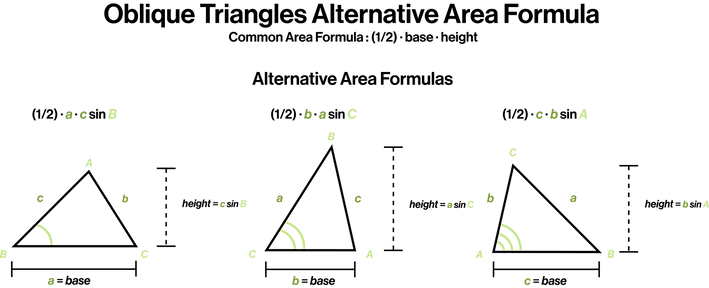
Law of Sines: A method used to determine the angles and side lengths of oblique triangles. The Law of Sines can only be used when SAA, ASA, or SSA are known. An alternative area formula for oblique triangles exists that utilizes the Law of Sines.
The Ambiguous Case: If SSA is given, the information can either apply to one oblique triangle, one right triangle, no triangle, or two triangles.

Law of Cosines: A method used to determine the angles and side lengths of oblique triangles. The Law of Cosines can only be used when SAS or SSS are known.
Quadrilaterals

Quadrilaterals are classified based on the number of parallel sides they contain.
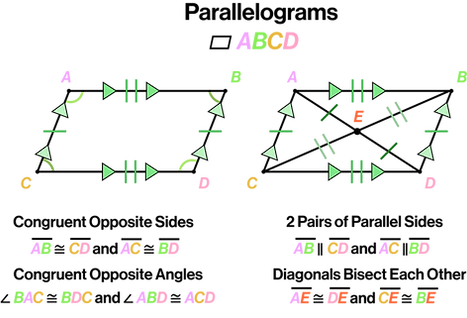
Parallelograms (▱): A quadrilateral that has two pairs of opposite sides that are parallel and congruent. The conditions for a quadrilateral to be a parallelogram are that its opposite sides are congruent, its opposite angles are congruent, its consecutive angles are supplementary, and its diagonals bisect each other. Parallelograms are named using a parallelogram symbol (▱) and the letters of its vertices.
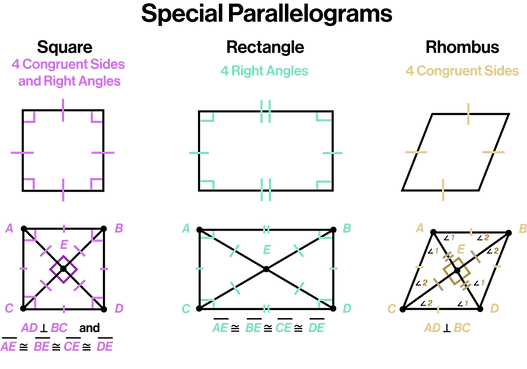
Squares: Parallelograms that have four congruent sides and four right angles.
Rectangles: Parallelograms that have four right angles.
Rhombuses: Parallelograms that have four congruent sides.

Trapezoids: Quadrilaterals that have a single pair of parallel sides. The parallel sides are the bases of the trapezoid, and the nonparallel sides are the legs of the trapezoid.
Isosceles Trapezoids: Trapezoids that have congruent legs.
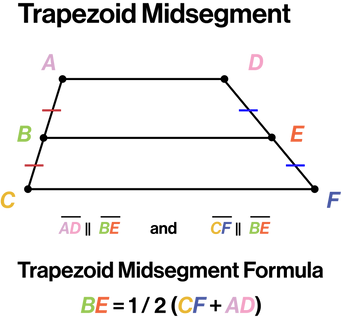
The midsegment of a trapezoid is parallel to the trapezoid's bases, and has a length that is half the sum of the lengths of the bases.

Kites: Quadrilaterals that have no congruent opposite sides and two pairs of congruent consecutive sides.
Similarity and Proportionality

Ratio: A quotient that compares two quantities with the same or different units. A ratio can be written in fraction or colon notation.

Extended Ratios: Ratios that compare three or more numbers. Extended ratios are used in geometry to provide information about triangles.

Proportion: An equation stating two ratios are equal.
Proportionality Test (Cross Products Test): A method of determining if two ratios are equal. The test involves checking if the cross products of the two ratios are the same.

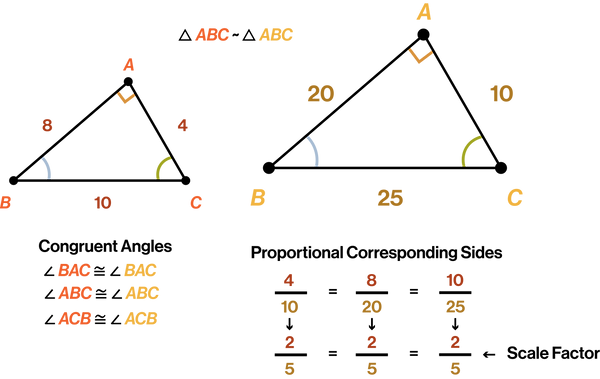
Similar Polygons (~): Polygons that have congruent angles and proportional corresponding side lengths. The tilde symbol (~) indicates that polygons are similar.
Scale Factor: The simplified ratio of all corresponding side lengths.

There are three ways to confirm if triangles are similar with limited information.
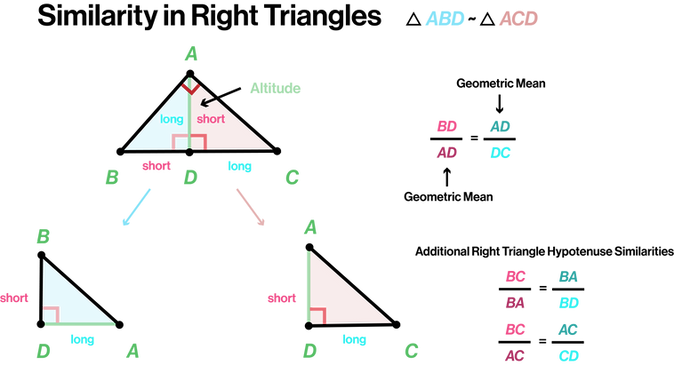
The altitude to the hypotenuse of a right triangle divides the right triangle into two triangles that are similar to one another and the original right triangle.
Geometric Mean: Proportional ratios with equivalent means.

If a line is parallel to one side of a triangle and intersects the two other sides of the triangle, then the two intersected sides are divided proportionally.

If a ray bisects an angle of a triangle, then it bisects the side opposite the angle into two segments that are proportional to the other two sides of the triangle.
Circles
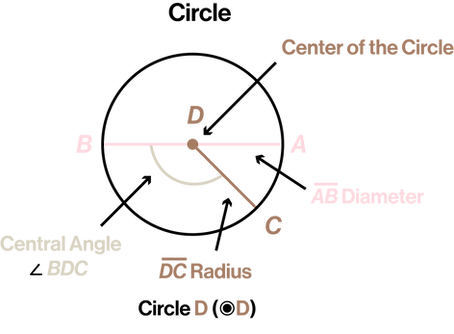
Circles: A set of points where the points are all equidistant from the center.
Diameter: A segment that contains the center of a circle and has both endpoints on the circle.
Radius: A segment that has one endpoint at the center of the circle and the other endpoint on the circle.
Central Angle: An angle whose vertex is the center of the circle.

Arcs: Portions of a circle. All arcs are named using the arc symbol (⌒). Minor arcs are named using the two endpoints on the arc. Major arcs and semicircles are named using the two endpoints on the arc and an additional point on the arc.
Semicircle: An arc that is half of a circle.
Minor Arc: An arc that is smaller than a semicircle.
Major Arc: An arc that is larger than a semicircle.

Semicircles equal 180°, minor arcs measure less than 180°, and major arcs measure greater than 180°.

Adjacent arcs can be added together to give the measure of a combined arc.
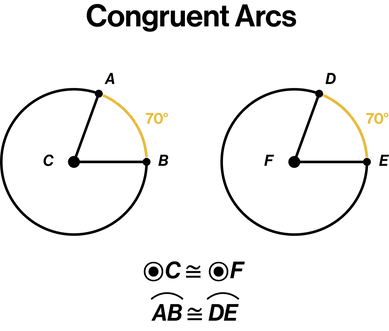
Congruent Arcs (≅): For arcs to be congruent, their circles must be congruent, and they must share the same angle measurement.


Tangent to a Circle: A line in the plane of a circle that intersects the circle at exactly one point. A line that is tangent to a circle is perpendicular to the circle's radius.
Common Tangents: Lines that are tangent to more than one circle.
Congruent Tangent Segments (≅): Two segments that are tangent to a circle and share a common endpoint outside the circle are congruent.

Chords: Segments that have both endpoints on the same circle.
Chords and arcs within the same circle have several theorems that apply to their congruence.
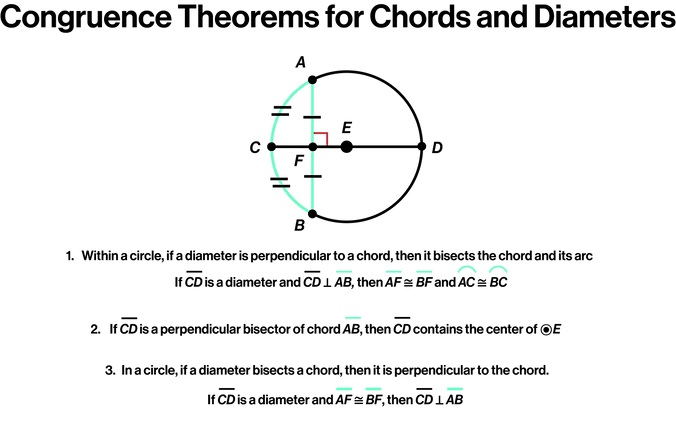
Several theorems apply to diameters and chords that share a circle.


Inscribed Angle: An angle whose vertex is on the circle and whose sides are chords of the circle.
Intercepted Arc: An arc created by an inscribed angle.

The measure of an angle formed by a tangent and a chord can be determined using its intercepted arc.

The measure of an angle produced by two intersecting lines inside a circle is half the sum of the measures of the intercepted arcs.

The measure of an angle produced by two intersecting lines outside a circle is half the difference of the measures of the intercepted arcs.

Three formulas can be used to determine the length of segments inside or outside of a circle.
Transformations and Symmetries

Transformation: A change to a figure's position, shape, or size.
Preimage: The original figure.
Image ('): The figure after being transformed. The prime symbol (') is applied to each of the transformed figure's vertices.
Rigid Transformation (Isometry): A transformation in which the preimage and image remain congruent.

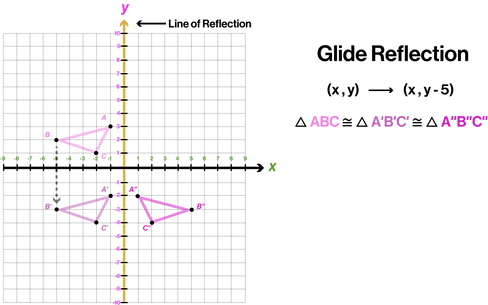


Translation: A transformation that moves all the points of a figure the same distance and in the same direction.
Reflection: A transformation in which a figure is flipped across a line of reflection.
Rotation: A transformation in which a figure is turned about a specific point, the center of rotation.
Glide Reflection: A translation followed by a reflection.

Dilation: A nonrigid transformation in which a figure is reduced or enlarged about a center of dilation.
Scale Factor of a Dilation: The number that describes by how much a figure is enlarged or reduced.


Rotational Symmetry: A figure has rotational symmetry if a portion of the figure is itself when rotated 180° or less.
Angle of Rotation: The smallest angle needed for a figure to rotate onto itself.
Reflectional Symmetry: A figure has reflectional symmetry if the figure on one side of the line of symmetry is the reflection of the figure on the other side of the line.
Area, Perimeter, and Circumference
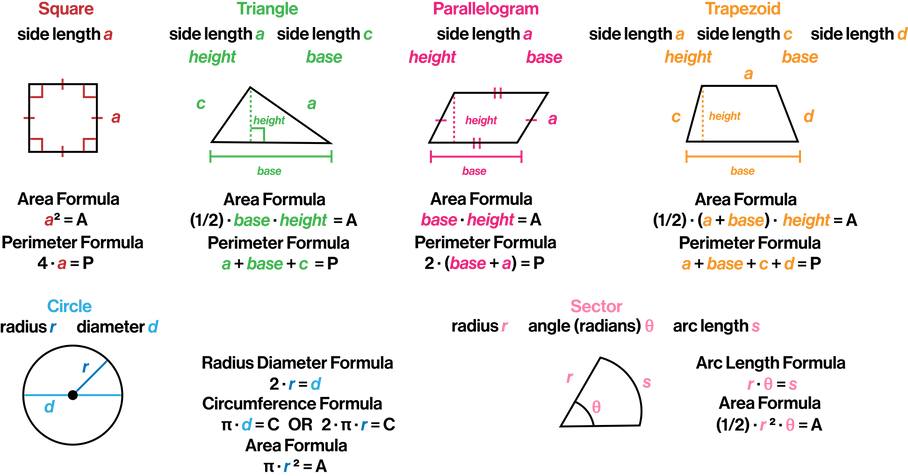
Perimeter: The distance around a geometric figure.
Circumference: The distance around a circle.
Area: The number of square units a geometric figure encloses.
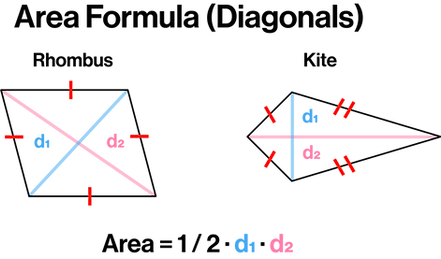.png)
Rhombuses and kites can have their area determined using the lengths of their diagonals.

Center of a Regular Polygon: The center of a circle circumscribed about a polygon is also the center of the polygon.
Radius of a Regular Polygon: The distance from the center of the polygon to a vertex.
Central Angle of a Regular Polygon: An angle whose vertex is the center of the polygon and whose sides are two consecutive radii.
Apothem: The perpendicular distance from the center to a side of the polygon.

For a set of similar figures, there is a direct relationship between the ratio of their area, the ratio of their perimeter, and their scale factor.

Pi: An irrational number that is approximately equal to 3.14. Pi can be described as the ratio of a circle's circumference to its diameter. Pi is used for multiple sector and circle formulas.

Alternative formulas, expressed in degrees rather than radians, exist that solve for the length of an arc and area of a sector.

By subtracting the area of a triangle from the area of a sector, the area of a segment can be determined.
Solids
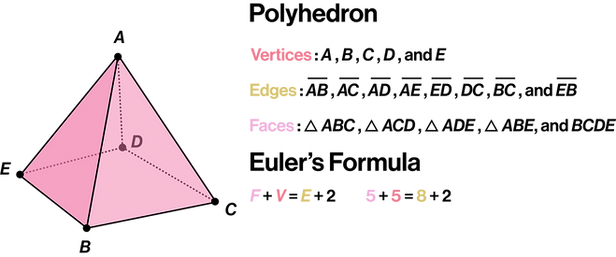

Solids: Three-dimensional shapes that have height, width, and length.
Polyhedra: Solids whose surfaces are made of polygons.
Vertices: Points where three or more edges intersect.
Edges: Segments formed by the intersection of two faces.
Faces: Each of the polygons of a polyhedron.
Euler's Formula: A formula used to determine the number of faces, vertices, or edges that a polyhedron has.
Solids of Revolution: Solids formed by rotating a flat shape about a line.


Cross Section: The intersection of a solid and a plane. Cross-sections can form two-dimensional shapes such as circles, triangles, or squares.
Great Circle: The center of a circle produced by a cross section that is also the center of the sphere.
Hemisphere: Half of a sphere.


Lateral Area: The area of a solid's lateral faces.
Surface Area: The total area of all of a solid's faces.
Volume: How much space an object occupies.
Prisms: Polyhedrons with two congruent, parallel faces, called bases. The other faces are referred to as lateral faces. Prisms are named based on their base shape.
Cylinders: Solids that have two congruent parallel bases that are circles.
Pyramids: Polyhedra that have one face, the base, that can be any polygon. The other faces of a pyramid are triangles that meet at a common vertex. Pyramids are named based on their base.
Cones: Solids with one base, a circle, and a vertex that is not in the same plane as the base.
Spheres: The set of all points in space equidistant from the center of the sphere.

How the height of a solid is measured depends on whether it is a right solid or an oblique solid.

Cavalieri’s Principle: If different solids have the same cross-sectional area at every level and the same height, then the solids have the same volume.

Similar Solids: Solids that have the same shape and have corresponding dimensions that are proportional. The scale factor ratio produced by a set of similar solids directly relates to the set's surface area ratio and volume ratio.
Coordinate Geometry

Coordinate Plane: A two-dimensional surface used to graph points, lines, and curves. A coordinate plane is composed of a horizontal number line, the x-axis, and a vertical number line, the y-axis.
Origin: (0,0) on the coordinate plane.
Ordered Pairs (X , Y): Used to locate points on a coordinate plane. A point's x-coordinate is written first, followed by its y-coordinate.


Coordinate Plane Midpoint Formula: The midpoint is found by determining the average of the x-coordinates and the average of the y-coordinates of the endpoints.
Coordinate Distance Formula: Used to calculate the distance between two points.
Coordinate Slope Formula: The ratio of the vertical change (rise) to the horizontal change (run) between two points.

X-Intercept: The point where a line or curve intersects the x-axis.
Y-Intercept: The point where a line or curve intersects the y-axis.

Linear Equations: Equations that represent a straight line when graphed.

To find a perpendicular line, calculate the negative reciprocal of the line of interest’s slope. If the lines are perpendicular, the product of their slopes is negative one.
Practice Sheets
bottom of page