top of page

Place Values
Digit: A number that names a place value location (0, 1, 2, 3, 4, 5, 6, 7, 8, 9).
Periods: Groups of three digits separated by commas. Different periods have different names.

Place Value: The value of a digit based on its position in a number.
Place Value Chart: A tool used to identify where digits are positioned in a number.

Whole Numbers
Natural Numbers: The counting numbers that range from one to infinity.
Whole Numbers: Zero and the natural numbers.

Standard Notation: Numbers are represented by digits. A comma is located between each set of three digits.
Expanded Notation: Each digit and its place value name are isolated. A plus sign "+" separates each digit and its place value name.
Word Name: The spoken name of a number.
Number Expanded Notation: An alternative form of expanded notation that uses zeros instead of place value names. A plus sign "+" separates each number in number expanded notation.

Integers
Integers: Whole numbers and their additive inverses.
Additive Inverse: The opposite of a given number. When a number is added to its additive inverse, it equals zero. Since zero is neither positive nor negative, it has no additive inverse and is not a positive or negative integer.

Positive Integers: The natural numbers that are right of zero, that range from one to infinity.
Negative Integers: The additive inverses of the natural numbers. Negative integers are found to the left of zero, and range from negative one to negative infinity.

Fractions
Fractions: Numbers that are composed of a numerator, a denominator, and a fraction bar.
Numerator: The number above a fraction bar. A numerator is equivalent to a dividend.
Denominator: The number below a fraction bar. A denominator is equivalent to a divisor.
Fraction Bar: The bar that separates a numerator from a denominator. A fraction bar is equivalent to a division sign "÷" and enacts the same operation.

Improper Fractions: Fractions with an equal or greater number in the numerator than in the denominator.

Complete Fractions: Improper fractions with the same number in the numerator and denominator. Complete fractions are equal to one.

Visual Representations: Portions of a whole visually represent fractions. These representations can be portions of a circle, block, or line.

Equivalent Fractions: Fractions that represent the same value, but have different numbers in their numerators and denominators.

There are three ways to test equivalency: the cross-products test, long division, and fraction bars.

Fraction Bars: A visual aid used to determine equivalent fractions.

To produce an equivalent fraction, multiply the fraction of interest by a complete fraction. This is equivalent to multiplying by one

Simplified Fraction: A fraction with a numerator and denominator that only share one as a common factor.

To simplify a fraction, you must divide the numerator and denominator by their greatest common factor (GCF).
.png)
Sequential Simplifying: A multi-step approach to simplifying a fraction.
Alternatively, any shared factor can be used to divide the numerator and denominator; however, if the greatest common factor is not used, the resulting fraction will need to be simplified again.

Any integer or decimal value can be converted into a fraction by putting it over one.

Mixed Numerals
Mixed Numerals: Numbers represented by a whole number and a fraction less than one. Mixed numerals are commonly used to describe measurements made with devices such as rulers or tape measures.
.png)
Mixed numerals represent the sum of a whole number added to a fraction less than one.

Mixed numeral notation is used to represent an improper fraction.


Visual Representations: Mixed numerals are represented by one or multiple complete models and a single incomplete model.

Ratios
Ratio: A quotient that compares two quantities with the same or different units. A ratio can be written in fraction or colon notation.
Rate: A ratio that compares two different kinds of units.
Units: Standardized measurements that are used to describe the magnitude of a quantity.

.png)
Ratios are written in colon notation or fraction notation. Ratios use "to" to describe the division bar in word form. Rates use "per" to describe the division bar in word form.


Simplifying a ratio may result in the loss of statistical and descriptive data.

.png)
Units can be converted, combined, or eliminated by multiplying by a ratio.
When like units are opposite of each other, they cancel out.

When like units are across from each other, they combine to give an exponent form of the unit.
.png)
Proportion: An equation stating that two ratios are equal.

The same processes used to determine if fractions are equivalent can be used to determine if ratios are proportional.
Decimals
Decimal Point: The dot that separates digits occupying whole number place values from digits occupying decimal place values.
Decimal Digits: Digits that occupy place values right of the decimal point.
Decimal Place Values: Place values found to the right of the decimal point.


Numbers in decimal form can be converted to fraction form by identifying the number of decimal places.

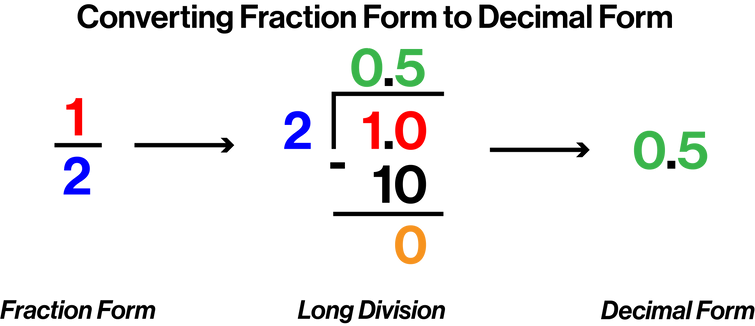
Long division can be used to convert numbers in fraction form to decimal form.
.png)
Percentages
Percent Notation (%): Numbers are written as parts per one hundred. The percent symbol indicates that a number is in percent notation.
.png)
Percentages can be converted to decimal notation via ratio notation, decimal notation, or fraction notation.

Percent notation represents how much of a portion makes up a whole.

Pie Chart: Pie charts visually represent fractions and percentages.

To determine a specific percentage of a number, multiply the number by the decimal form of the percentage.

Negative Numbers
Negative Numbers: Numbers to the left of zero on a number line.

When solving an equation, the number of negative numbers and their position in the equation affect the sign of the resulting number.

Absolute Value |x|: The distance that a number is from zero. Absolute values are always nonnegative because distance is always nonnegative.

Number Lines
Number Line: A straight line with numbers placed at equivalent intervals along its length.

Number lines may or may not use simplified fractions.

Graphs and Tables
Pictograph: A visualization of data that uses symbols. Each symbol represents a quantity.

Pie Chart: A circular visualization of data. Categories are split into sectors whose sizes correspond to the number associated with each category.

Bar Graph: A visualization of data that uses bars which are proportional in length to the numbers they represent.

Line Graph: A graph in which points represent values. Straight-line segments connect the points.

Histogram: A graph that shows how often certain numbers appear in a set of data.

Stem-and-Leaf Plot: A diagram that shows the frequency distribution of a set of data. The stems are the first digits of the numbers. The leaves are the last digit of the numbers.

Data Table: Data is shown in rows and columns.

Frequency Table: A table that displays the number of times a value or values appear in a set of data.

Practice Sheets
bottom of page