
Greek Alphabet

Time
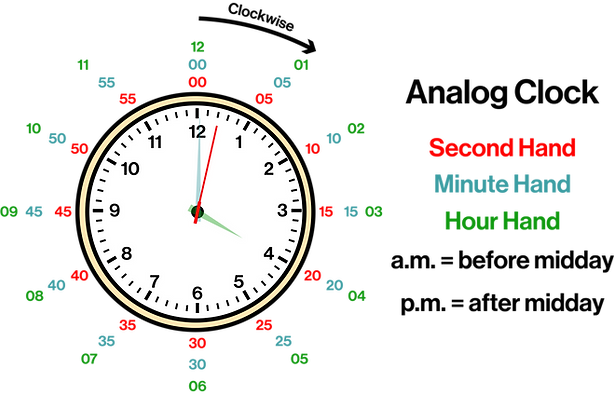
Analog Clock: Time is displayed on a dial with reference marks and revolving hands. Analog clocks are 12-hour clocks and use the a.m. and p.m. system to differentiate times of the same value.

Military Time: A 24-hour clock.
Interest
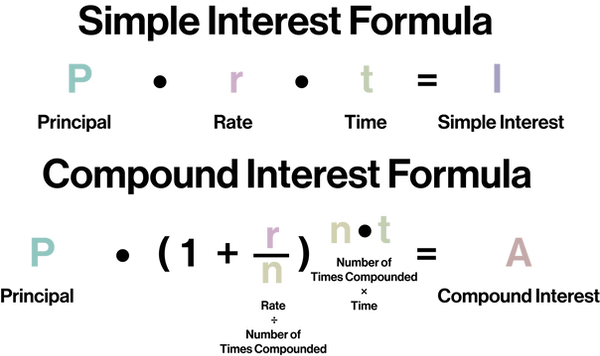
Interest: A percent of an amount of money that has been invested or borrowed.
Interest Rate: The percent at which interest is calculated on a principal.
Principal: An amount of money that is invested or borrowed.
Simple Interest: Interest remains constant throughout the loan or investment.
Compound Interest: Interest is added each period to the principal, thus increasing the amount of interest received from future periods.
Geometric Probability



The probability formula can be applied to geometry.
Conic Sections

Conic Sections: Curves generated by the intersection of a cone and a plane. Conic sections include circles, ellipses, parabolas, and hyperbolas.

Circle: A set of points where the points are equidistant from the center.

Parabola: A set of points where the distance between a given point and the directrix is equal to the distance between the same point and the focus.

Ellipse: A set of points where the sum of the distances from the foci is constant.

Hyperbola: A set of points where the absolute value of the difference of the distances from the foci is constant.
Decomposing Rational Expressions

Rational expressions can be decomposed into the sum of simpler rational expressions.

If the polynomial in the numerator has a degree that is equal to or greater than the degree of the denominator, polynomial division is required.

The irreducible polynomials in the denominator of a rational expression determine its decomposition.
Rotation of Axes

When the variable B of a second-degree conic equation is a nonzero number, the axes are rotated.


Points and equations in the xy system can be converted to the x’y’ system and vice versa.
Polar Equations of Conics

.png)

Polar equations can correspond to conic sections.

Conic equations in polar form can be graphed manually or with a graphing calculator.
Parametric Equations


Parametric Equations: Equations where x and y are functions and t is a third variable. x=f(t) and y=f(t) are parametric equations for the curve, and the variable t is the parameter.

There are infinitely many sets of parametric equations that represent the same curve.
Sequences and Series

Infinite Sequence: A function with a domain that is the set of consecutive positive integers beginning with one and a range that is the set of terms in the sequence.
Finite Sequence: A function with a domain that is a set of consecutive positive integers beginning with one for some positive integer n and a range that is the set of terms in the sequence.

Infinite Series: The sum of the terms of a sequence.
Partial Sum (Finite Series): The sum of the first n terms of a sequence.
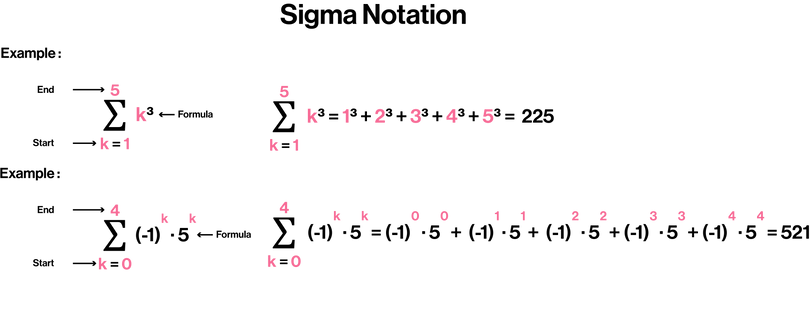
Sigma Notation: A notation that represents the sum of a sequence. The infinity symbol is used for the sum of an infinite sequence.


Arithmetic and geometric sequences and series have special properties.